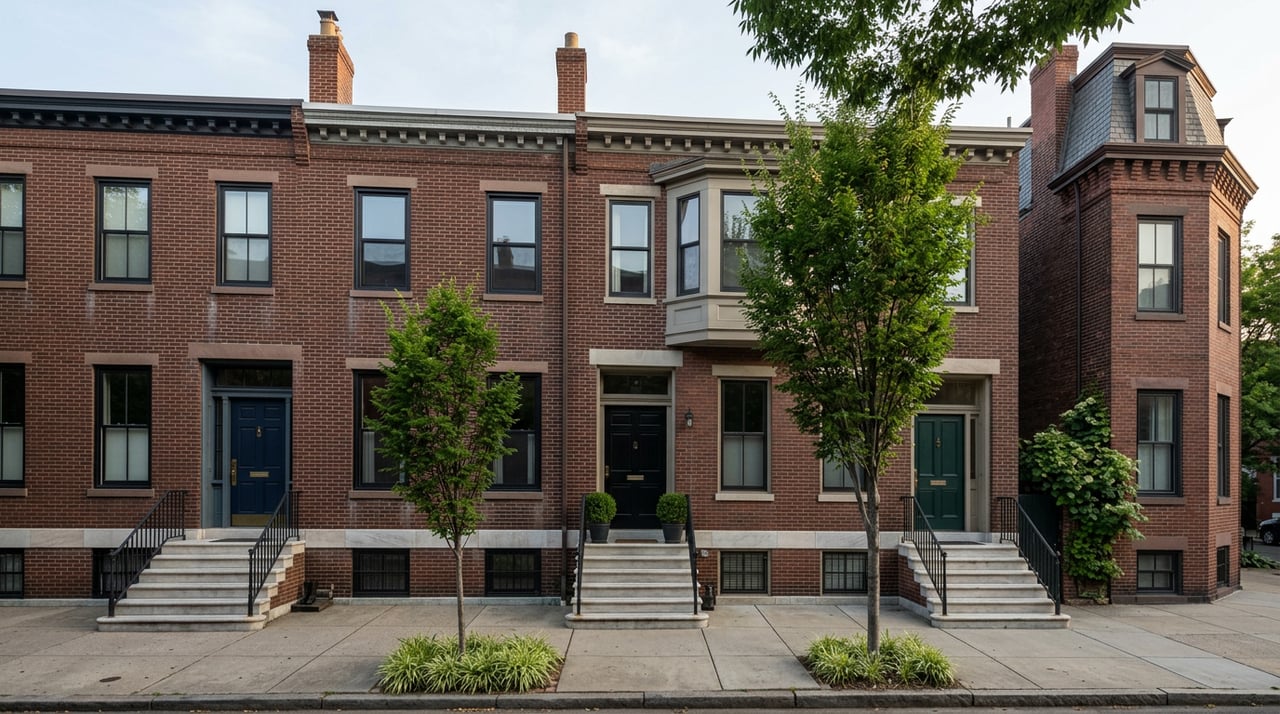
A title search comes back on a rowhouse in Fells Point or Federal Hill, and there it is: "subject to ground rent." The buyer reads that phrase and hears something alarming, as if they are about to buy a house that sits on land someone else could reclaim. The seller, who has owned the place for years and paid a small semiannual bill without thinking twice about it, is caught off guard that it is even coming up now.
Neither reaction is really about the right problem. The dollar figure attached to a Baltimore ground rent is almost never what threatens a closing date. What threatens it is how long it takes to clear the paperwork once everyone realizes it needs clearing, and most purchase contracts do not build in enough time for that.
What Ground Rent Actually Is
In a fee simple purchase, you own the house and the land under it. With a ground lease, you own the structure but a separate party still owns the ground, and you pay them a small annual or semiannual fee for the right to sit on it. It is a leasehold arrangement, typically written for 99 years and renewable forever, and the payments involved are modest, usually in the range of $50 to $150 a year, occasionally a bit more.
This structure is old. Baltimore developers used it as a financing tool going back to the city's earliest rowhouse blocks, letting a buyer purchase the building without also fronting the cost of the land, which kept homeownership within reach for more people. Eric Holcomb, executive director of Baltimore's Commission for Historical and Architectural Preservation, has described the rowhouse as the form that ties the whole city together, and ground rent is part of why that form spread so widely through neighborhoods like Fells Point, Federal Hill, Canton, Locust Point, Butchers Hill, and Pigtown. Maryland banned the creation of new residential ground leases in 2007, so every one you encounter today is a legacy instrument, not a new financial product someone is trying to sell you.
None of that is the part that catches people off guard.
The Question That Actually Matters: Is It Registered?
Most guides to Baltimore ground rent walk straight past this and go to redemption math. Check the registration status first.
Every ground lease has to be registered with the Maryland Department of Assessments and Taxation to be legally collectible. If it is not in the SDAT Ground Rent Registry, the holder cannot collect back rent and cannot file suit to enforce it. A ground rent showing up on a title abstract does not automatically mean someone has to write a check or start a redemption process. It means someone has to check the registry, and that single lookup can eliminate the entire issue before anyone spends a dollar or a day chasing it.
This matters most for sellers of older rowhouses who assume a ground rent noted decades ago in the land records is still a live, enforceable obligation. Sometimes it is. Sometimes it was never registered, or the registration lapsed, and the practical answer is that there is nothing to redeem because there is nothing anyone can legally collect.
The Redemption Math Is Not the Obstacle
When a ground rent is registered and active, Maryland law sets the buyout price by formula, not negotiation. You divide the annual rent by a 6 percent capitalization rate, which is the same as multiplying the annual rent by 16.66. A $90 annual ground rent redeems for $1,500. A $150 annual ground rent redeems for $2,500.
| Annual Ground Rent | Redemption Cost (÷ 0.06) |
|---|---|
| $50 | $833 |
| $90 | $1,500 |
| $100 | $1,667 |
| $150 | $2,500 |
That is the entire financial exposure in most cases, and it is small relative to what a Baltimore rowhouse sells for today. The Maryland Residential Ground Rent Redemption Program, reachable at 410-767-1353, exists specifically to walk homeowners through this, and the state simplified the application process in 2022. Redemption itself is a three-step process: pay the statutory amount, get a signed redemption deed from the ground rent holder, and record that deed in the county land records. None of those three steps is expensive. The second one is where deals stall.
Where the Real Delay Comes From
Ground rent holders are not always easy to find. A lease created in 1935 has often changed hands multiple times since, sometimes through an estate, sometimes sold off in a bundle to an investment company that has since merged, renamed, or moved. Locating the current holder, confirming the payoff amount, and getting a signed release recorded can take anywhere from the same day to several weeks, depending entirely on how responsive that party is.
Lenders complicate this further. Some conventional and government-backed loan programs require full redemption before they will fund, treating leasehold as too much of a wrinkle on the collateral. Others will accept a leasehold interest under specific conditions, or allow funds to sit in escrow while redemption finishes after closing. None of this is standard across every deal. It gets negotiated, and it needs to be negotiated early, because finding out your lender requires redemption a week before closing is a very different conversation than finding out at contract signing.
If you are under contract on a rowhouse with a registered ground rent, ask for the estoppel letter and payoff figure before you get anywhere near your closing date, not after your lender flags it during underwriting.
The "Irredeemable" Label Is Not Always True Anymore
Some very old Baltimore ground leases, created before April 9, 1884, were written as irredeemable, meaning the original terms gave the leaseholder no right to buy out the ground at all. On paper, that sounds permanent. In practice, it usually is not anymore.
Maryland law requires anyone holding an irredeemable ground rent to file a notice of intention to preserve that irredeemability in the county land records, and then refile it every ten years. The first deadline for that initial notice was December 31, 2010. If a holder never filed, or filed once and then let a later ten-year renewal lapse, the ground rent automatically converts to a redeemable one, whether or not anyone bothered to update the land records to reflect it. Over a century and multiple generations of ownership, a lot of these renewal notices simply never got filed.
That means a deed that still describes a ground rent as irredeemable is not proof that it actually is. It is worth a records check before anyone accepts that label at face value, because the difference between "we cannot touch this" and "we can redeem this for a few thousand dollars" comes down to whether a piece of paper got refiled on schedule decades ago.
What This Means If You're Buying or Selling
If you're selling a rowhouse with a registered, active ground rent, redeeming it before you list removes a line item that can otherwise slow a buyer's lender down, and it is a small cost against your sale price. If you'd rather not redeem it yourself, a credit at closing so the buyer can handle it is a common and reasonable alternative.
If you're buying, confirm registration status before you assume you owe anything, request the ground rent instrument and any assignments as soon as your title company opens the file, and build real time into your contract for locating the holder and recording a release. A week of contingency buffer costs you nothing. Discovering the holder is unresponsive four days before closing costs you your rate lock.
A Short FAQ
Does ground rent mean I don't fully own my house? No. You own the structure outright. The ground rent holder's only right is to collect the annual payment, not to occupy or reclaim the property, as long as that payment is made.
What happens if a registered ground rent goes unpaid? The holder can pursue collection, and Maryland law allows them to add substantial fees before and during that process on top of the back rent owed, plus interest in some cases. It rarely reaches that point, but staying current or redeeming outright removes the risk entirely.
Can a seller be forced to redeem before closing? Not automatically. It is a point of negotiation between buyer and seller, often shaped by what the buyer's lender will accept.
Does this apply to condos? Occasionally, and it is worth asking whether the association or the individual unit owner is responsible for any ground rent tied to the building, since that answer varies by property.
Ground rent in Baltimore is a solvable piece of paperwork, not a reason to walk away from a rowhouse you love. The teams that get burned are the ones who find out about it late. The teams that don't are the ones who ask the registration question in week one and build the timeline around the answer.
If you're weighing a rowhouse purchase or listing in Baltimore, Columbia, or anywhere else across the DMV, the Anthony Lacey Home Team can walk through exactly what a title report like this means for your specific timeline. Schedule a Free Consultation and let's map out the path before it becomes a scramble.